Midjourney vs DALL·E 3: Photorealism, Text, and Prompt Routes
Midjourney for a photorealistic feel; DALL·E 3 for scenes exactly as described and for text. Decide the use first and the route gets shorter.
Route
Other routes (trying it first without a subscription)
FAQ
A closer look
Which jobs suit Midjourney, and which suit DALL·E 3?
If a photorealistic feel comes first, choose Midjourney; if a scene exactly as described and text come first, choose DALL·E 3. The comparison article used as the source judged Midjourney V6 to be ahead of DALL·E 3 in photorealism, and named Midjourney's vivid, pretty photorealistic images as a strength.
Conversely, for scenes with many layered requests, or for text inside the image, DALL·E 3 comes first. The same article wrote that DALL·E 3 is excellent at accurately understanding and drawing the detailed requests in a command. Storybook illustrations and light business promotional images appear as examples of use.
For people trying AI art for the first time, the impression is that DALL·E 3, which you can use just by describing in words, has a lower threshold. However, this is only the author's assessment, not an official figure. The fact that you use DALL·E 3 inside ChatGPT, while Midjourney is handled with keywords and its own commands, also affects your choice.
What exactly is different between the two stars, and how do they diverge when asked for the same scene?
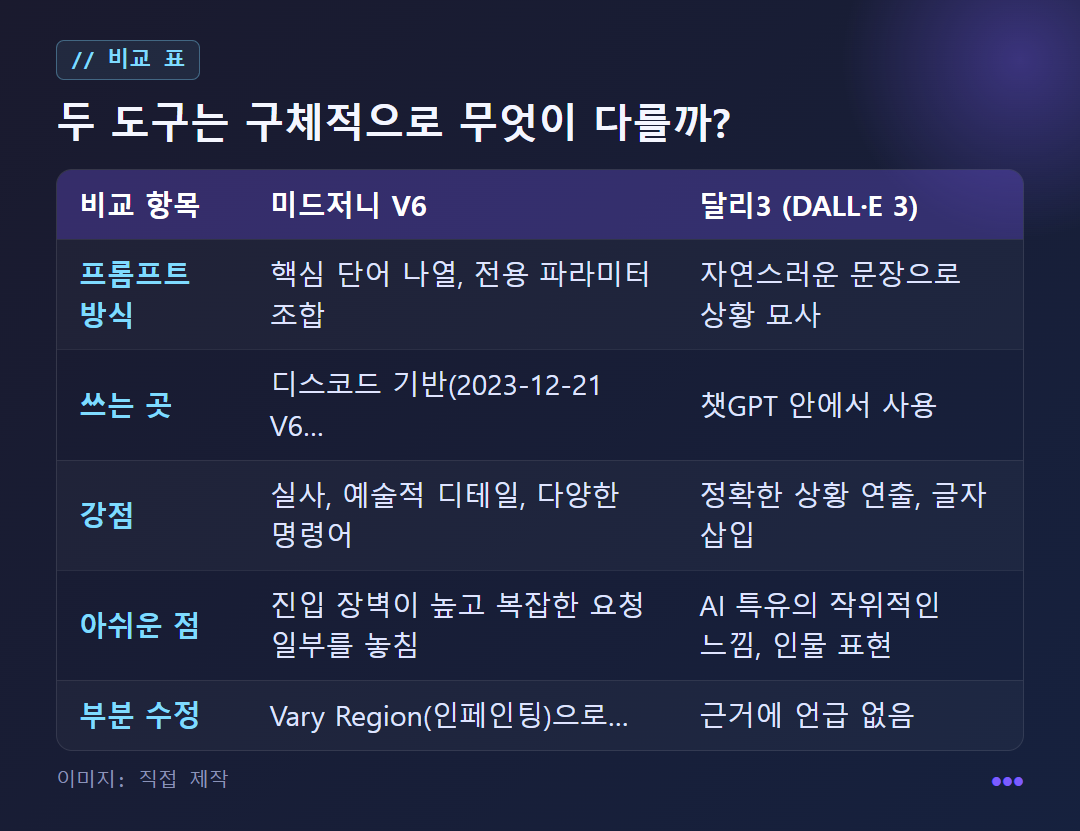
The prompt style, where you use them, and their strengths all differ. Midjourney lists key words and combines its own parameters. According to the source article, the date V6 was activated on Discord is 2023-12-21. DALL·E 3 describes the situation in natural sentences inside ChatGPT.
Midjourney's strengths are photorealism, artistic detail, and a variety of commands, while DALL·E 3's are accurate scene staging and text insertion. On the downside, Midjourney has a high barrier to entry and misses some complex requests, while DALL·E 3 has an artificial, AI-typical feel and weaker depiction of people. Midjourney has inpainting that redraws only part of an image (Vary Region), which can fix awkward hands or eyes to some extent. The source does not say whether DALL·E 3 has the same feature, so check the official page.
Here is one test from the source article. It was a long request: on a sheet of paper on a desk, a boy toy tries to touch a cat toy, and the sea is visible through a large window in the back. DALL·E 3 reflected it almost exactly, but Midjourney failed to depict the cat and the child as toys and placed the child under the desk. It reportedly did the same even after several regenerations.
For simple requests, both were accurate and differed only in how they expressed things. Neither could write long phrases. The longer and more complex the request, the more DALL·E 3 has the advantage, and the shorter it is, the smaller the difference. Keep in mind that this test is a personal blog's assessment from late 2023. You can read the details in the source article.
Why do the results differ when you enter the same prompt?
It is because the two stars read prompts differently. According to the source article, Midjourney is strong at combining comma-separated clumps of keywords into visual patterns. DALL·E 3 understands conversational sentences that carry context well. If you write long abstract descriptors like 'relaxed' or 'warm' in Midjourney, it easily loses its way, and if you write only broken-up words in DALL·E 3, the AI adds its own imagination as it likes.
Here are examples you can try right away. They are adapted from the examples in the source article.
For Midjourney: A cat drinking coffee, cafe background --ar 16:9
For DALL·E 3: Draw a cat sitting by a sunlit window, drinking a latte. Write 'COFFEE' on the mug.
When moving from Midjourney to DALL·E 3, delete dedicated parameters like --ar and join the words into a short story. In the other direction, cut the descriptive phrases and keep only the key nouns. If that is a hassle, the source article also mentions asking ChatGPT to "rewrite this sentence as a list of words suited to a Midjourney prompt." The source is this prompt structure comparison article.
How much can you use for free, and what alternatives are there if you like neither?
Midjourney is built mainly around subscriptions. A 2026 alternatives comparison article explains that there is effectively no free plan you can use freely. It also says commercial use is possible, but the conditions may vary by subscription tier. The source gives no specific pricing, so check the official Midjourney site.
DALL·E 3 is built into ChatGPT. One blog post complained that ChatGPT often hits usage limits and generates only two images at a time. That reflects the time the post was written, so check the official OpenAI page to see whether the current limits are the same.
Alternatives are listed in this Midjourney alternatives comparison article. Leonardo AI is described as used in a web interface and giving free tokens every day. Bing Image Creator appears as a free DALL·E-based alternative. FLUX.1 tends to render hands, facial structure, and body proportions naturally, and Adobe Firefly is said to be preferred for brand work that needs clear licensing. If text is the priority, Ideogram 2.0 is mentioned, and for fine-tuned control on a local PC, Stable Diffusion is mentioned. The source gives no pricing for these services, so none is listed here, and it is safer to visit each one and check its current status yourself.
When might it be better not to use them?
For images where a person's hands, eyes, and mouth must look sharp, both stars need caution. The source article names DALL·E 3's depiction of people as its biggest weakness and cites cases of odd finger counts or strange pupils in long shots. Midjourney V6 also sometimes produced grotesque hands or unnatural eyes and mouths.
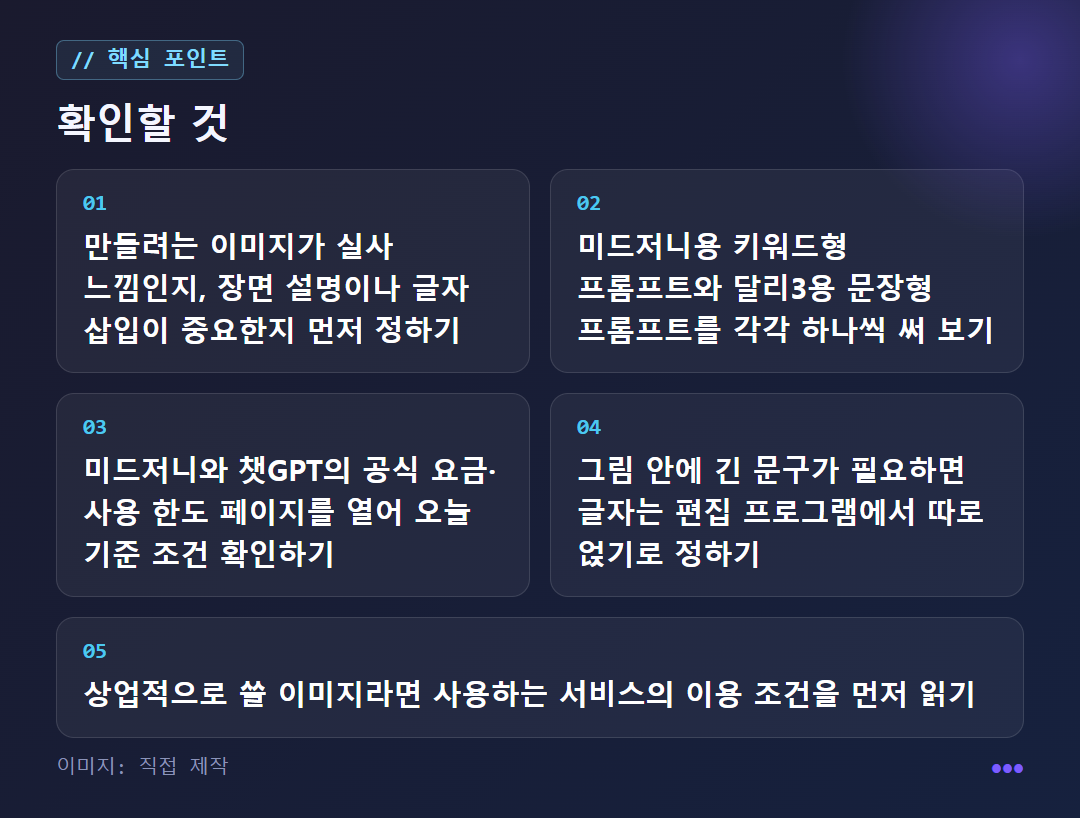
Work that requires placing long sentences accurately inside the picture is also a poor fit. In that case, it is better to leave text out of the image and add it in an editing program.
One point is easy to confuse. The forecast that DALL·E 3 would fall short of Midjourney in artistry was a prediction made from public samples before the official release. That article itself stated the limits of comparing samples. So read this comparison as an assessment from that time, not a settled ranking. Also avoid putting company secrets or other people's personal information in your prompts.
✦ See this star on the 3D map