Refining AI Answers with Follow-Up Questions, One Thing at a Time
If the first answer is slightly off, don't start over. You can fix it one line at a time in the same window. Here are sentences you can copy and use.
Read the last answer and pick just one spot you want to fix. One paragraph, one tone, or one term is enough.
Rewrite only the second paragraph. Add one example, and leave the other paragraphs as they are.
Replace the difficult terms in your last answer with words a middle schooler would understand. Keep the structure and order.
Show this answer again, separating what you're sure about from what you guessed.
Give me a list of items I should check myself before publishing this text.
FAQ

A Closer Look
The first answer went off orbit: launch a new one or fix it?
To put it simply, if the answer is about 80% right, fixing it in the same window is usually faster. A follow-up question is just a request added on top of an answer you already have.
Your first question always has conditions you left out. The first answer is where those gaps show up, so once you know where it went wrong, your next request becomes much more precise. You also don't have to explain everything built up in the conversation from the beginning again. If you've ever had AI work on a report draft, a notice, or an email reply, you can use this right away, and it isn't tied to any specific AI tool.
There's one thing to watch out for. The longer a conversation gets, the more the earlier instructions can fade. Restate important conditions in one line in your follow-up question.
How many requests should one question carry?
One. One article about running parent-teacher consultations gives an example: the sentence "I'm worried about my child's math grades and I also want to change next month's schedule" actually splits into a learning question and an administrative question. Since different staff handle them, handling them separately keeps follow-up work from being missed.
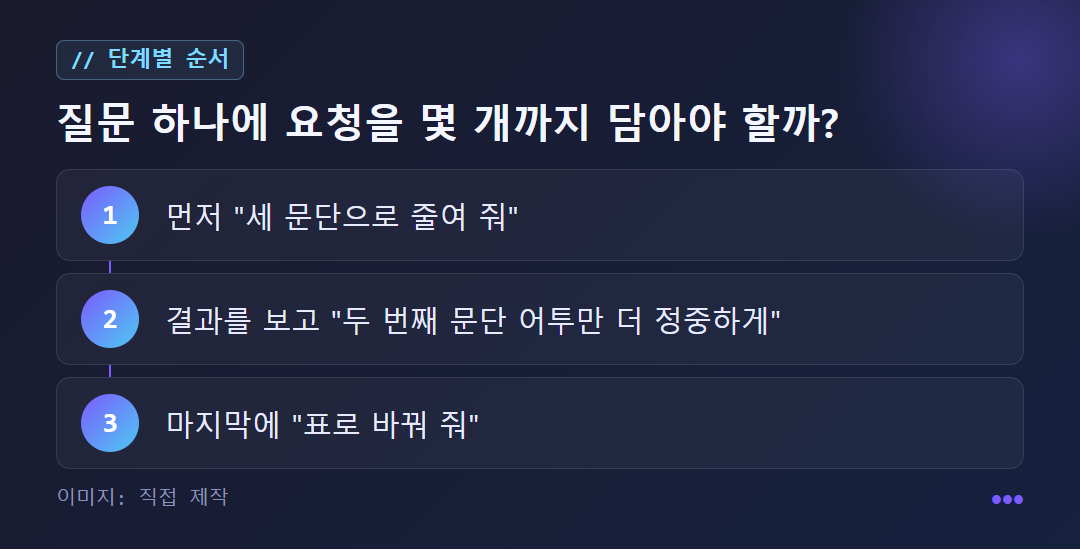
The same applies to AI. If you ask for four things at once, like "make it shorter, more polite, turn it into a table, and add an English translation," it's hard to tell what the problem is when even one of them goes wrong. Try splitting them up in order, like this.
1) First, "Shorten it to three paragraphs"
2) After seeing the result, "Make only the second paragraph's tone more polite"
3) Finally, "Turn it into a table"
If you change one thing at a time, then when something goes wrong, you know the cause is the request right before it.
What wording hits the target exactly?
The place to fix, the direction of the fix, and the part to leave alone. Just include these three things. "Write it a bit better" is a request where the AI doesn't know where to fix or how.
Here are examples you can copy and use right away.
"Rewrite only the second paragraph. Add one example, and leave the other paragraphs as they are."
"Replace the difficult terms in your last answer with words a middle schooler would understand. Keep the structure and order."
"Show this answer again, separating what you're sure about from what you guessed."
The third sentence is especially useful. Crisis communication training materials also say that you must first separate confirmed facts from what is still being verified so that a statement doesn't waver. The same order works when reviewing AI answers.
If an answer looks off, which starlight should you doubt first?
Ask for the basis and how to verify it. "Where can I check this?" or "Mark the parts you're not sure about separately" are good starting points.
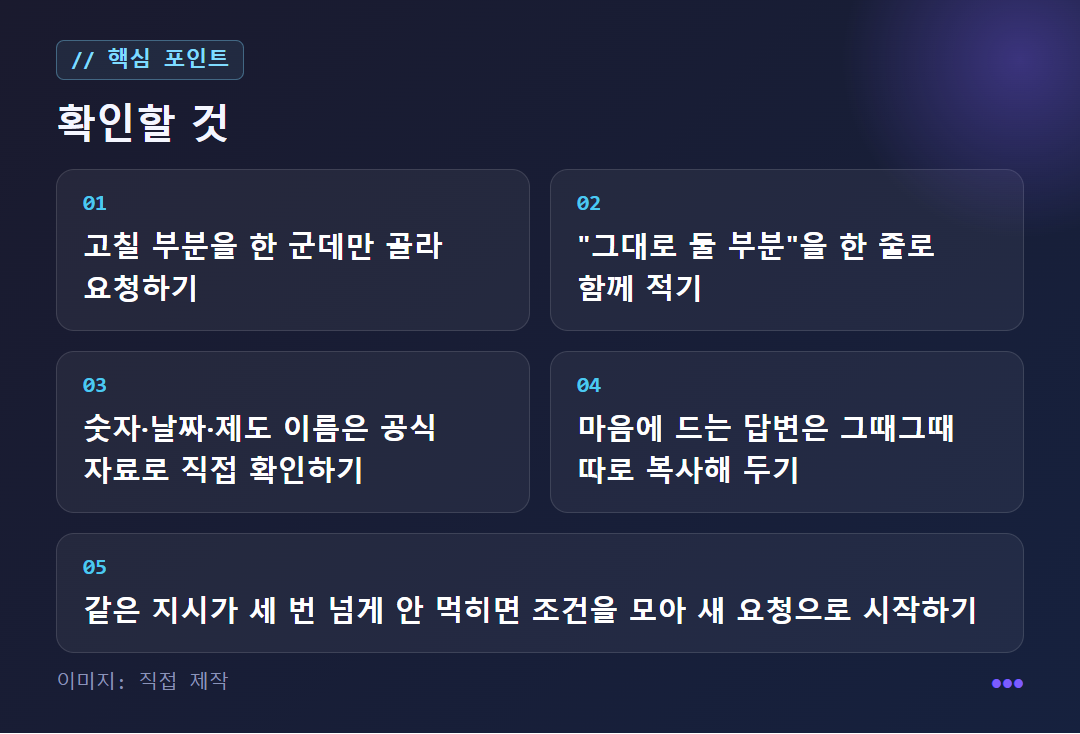
AI sometimes writes even the parts it doesn't know in confident sentences. So whenever numbers, dates, or system names appear, check them separately. Crisis management materials say that sorting out the scope of what is confirmed comes before giving an instant answer. They advise separating confirmed facts, what is still being checked, the range you can answer, and when an official answer will come.
This is a habit you can carry straight over to AI answers. For parts you can't confirm, it's safer to leave them out rather than write them as they are, or to write them only after checking an official source yourself. The basis for this article is not AI-specific documentation but practical material on counseling operations and crisis response, and the parts applied to using AI are general examples of use.
Where should follow-up questions stop, and what comes next?
When fixing one thing starts breaking other parts, it's time to stop. If you repeat the same instruction more than three times and it still isn't fixed, your conditions are likely conflicting with each other. In that case, it's better to start over with a new request that lists the organized conditions all at once.
There is also an easy point of confusion: a version you liked came up partway through, but you passed it by. Copy such answers separately as you go. Even if you say "Go back to the third version of the answer," it may not be restored exactly.
To wrap up, try asking, "Give me a list of items I should check myself before publishing this." An article on follow-up replies in counseling says that repeating the structure of fact, judgment, and next action makes replies short and accurate. Don't stop once you get the answer; get your own to-do items too, and the writing will carry into real work. The article I referred to is the post on parent consultation answer queues on the Edpen blog. It does not cover the features or pricing of any specific AI tool, so check that tool's official guidance separately.
✦ See this star on the 3D map