LangChain vs LlamaIndex: Which Should You Use? How to Choose
If document search is your goal, choose LlamaIndex; if you're heading toward agents that chain tools together, choose LangChain. In short: "the route you want to take decides it.".
Scoreboard by item
Winner by situation
Frequently asked questions
A closer look
LangChain and LlamaIndex: how are these two stars different?
Both are open-source frameworks for building RAG, but their focus differs. RAG is a method that lets an AI find relevant content in your documents and refer to it before answering. It's the first approach you'll encounter when you want a chatbot to read your internal documents.
IBM's explainer describes LlamaIndex as a tool focused on ingesting, indexing, and searching text data. That makes it a good fit for relatively simple workflows and simple AI apps. Its former name was GPT Index. LangChain has a modular structure that links components together, so it is said to be strong in broad natural language processing and in agentic AI apps that choose tools and carry out tasks on their own.
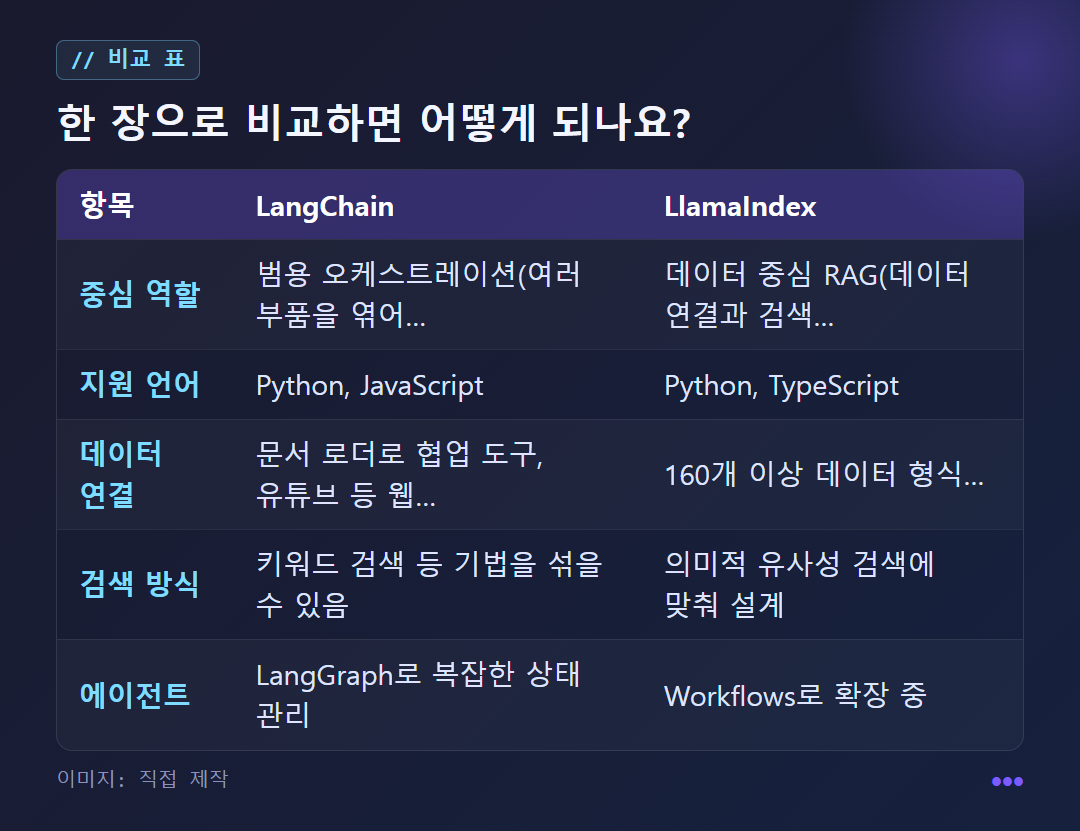
For supported languages, LangChain offers Python and JavaScript, while LlamaIndex offers Python and TypeScript. For data connection, LlamaIndex provides more than 160 data formats and LlamaHub connectors, while LangChain attaches collaboration tools, web content such as YouTube, and databases through document loaders. For search, LlamaIndex is designed around semantic similarity, and LangChain can mix in techniques such as keyword search. LangChain also has LangSmith for evaluation and LangServe for deployment. LlamaIndex's evaluation and deployment tools were not in the material we checked this time.
If I only build a document-search chatbot, which star is closer?
In this case, LlamaIndex is lighter to get started with. Data loaders bring in files, databases, and APIs, and embeddings build a searchable index. An embedding is a technique that turns sentences into numeric vectors so that texts with similar meaning can be found. After that, the index itself is used like a query engine. The Skywork material describes this as a way to do advanced search through a simple interface.
With LlamaHub, you can also combine different sources, such as APIs, SQL databases, and Google Workspace, into a single workflow. The official developer documentation introduces this framework as the original open-source toolkit for RAG and agents. You can see the starting page in the LlamaIndex official documentation.
LangChain, by contrast, provides several tools for chunking, meaning splitting documents into suitably sized pieces, and the developer combines them by hand. Even for the same job, it takes more effort. In exchange, it also means you can adjust things exactly as you like.
What if I plan to build agents or automation too?
For this route, LangChain is the better choice. The official documentation describes an agent as the sum of a model and a harness. The harness is everything surrounding the model loop, such as prompts, tools, and middleware that controls behavior. It states that it provides create_agent as a minimal harness with a wide range of settings. You can check this in the LangChain official overview.
The Skywork material rates LangChain's agent capabilities as very strong and says it handles multi-step reasoning with LangGraph's cyclic graphs. The same material also mentions more than 700 tool integrations, but that is the material's own claim, so it's safer to verify it yourself in the official documentation before adopting it.
It also has conversation memory. You can choose to keep the whole conversation, summarize the past, or keep only a recent portion. Another advantage is that you can continue on to LangSmith, which evaluates the app you built with a test dataset, within the same camp.
What are the downsides of each star?
LangChain's weakness is its learning curve. The Skywork material lists a steep learning curve and debugging complexity as drawbacks. Because it is so flexible, there are many choices to make, and beginners may not know where to start.
The same material says LlamaIndex is relatively limited in general-purpose agent features. The IBM explainer also describes LlamaIndex as centered on text-based data, and compares it by saying it supports images and text, while LangChain can load images and PDFs as well as online video and API data. In other words, if you want to handle video or online sources broadly, LangChain offers more variety.
There is one more point that is easy to confuse. The two tools look like competitors, but a hybrid setup that uses both is also possible. You don't have to pick only one. However, the setup gets more complicated, so we recommend starting with one of them first.
So which star should I start from? And what about cost?
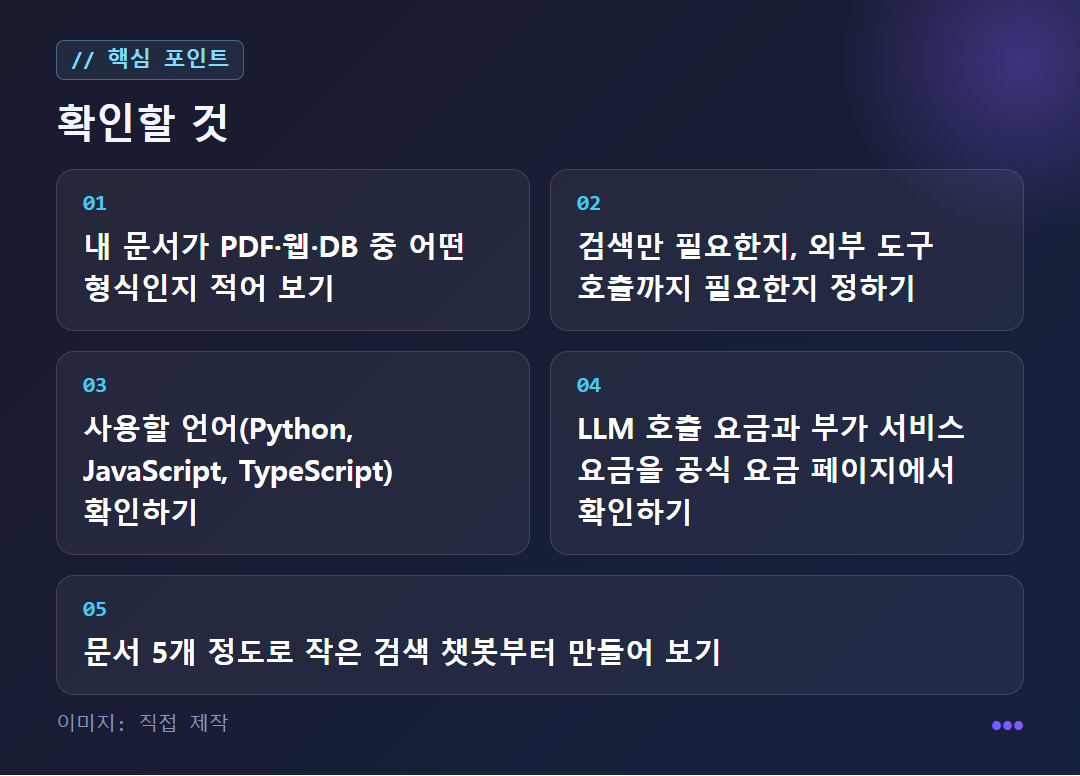
If your goal is a chatbot that answers questions about internal documents or a bundle of PDFs, and you have little development experience, start with LlamaIndex. You will spend your time refining search quality. If your goal is business automation that takes search results, calls external APIs, and decides the next action based on the results, LangChain is the better fit. If you are unsure about both, first write down what format your data is in. The more varied the formats and the longer the workflow, the more it leans toward LangChain; if it is text-focused and questions and answers are all you need, it leans toward LlamaIndex.
Here is how to think about cost. The two frameworks themselves are described as open-source toolkits, but the fees for the LLM calls you actually use, and for add-on services such as LlamaCloud and LangSmith, were not in the sources we checked. Please check each official pricing page. For reference, the paid e-book that covers both tools, the Leanpub book, was last updated on 2026-08-14, and it is stated that refunds are available within 60 days of purchase. It isn't required, so starting with the official documentation is enough.
This article is a comparison based on summaries of the official documentation and on explainers from IBM and Skywork. It is not a review from building and running these tools ourselves. Some sources are search summaries, so please double-check detailed features in the official documentation.
✦ See this star on the 3D map